Games for learning languages: free vocabulary games in the browser
Fluera’s language learning games combine course vocabulary with arcade action. Fluera Tower is a tower defense game where correct translations earn you gold. Fluera Jump is a vertical jumping game where the platforms are answers. Fluera Run is an endless runner where you steer into the right translation. All three use the same course words as your lessons, run in the browser on a phone or computer, and start without registration.
Choose a game
{# Crawlable fallback for the same cards mounted by PublicPracticeCards.jsx. Decorative SVG artwork is added by the shared client card component. #}The three games
Fluera Tower: tower defense
Enemies walk toward your base; you build and upgrade towers beside the road. Answer vocabulary questions with two translation options to earn gold for your defenses. Levels, stars and a campaign map give you reasons to keep playing. Read about Fluera Tower.
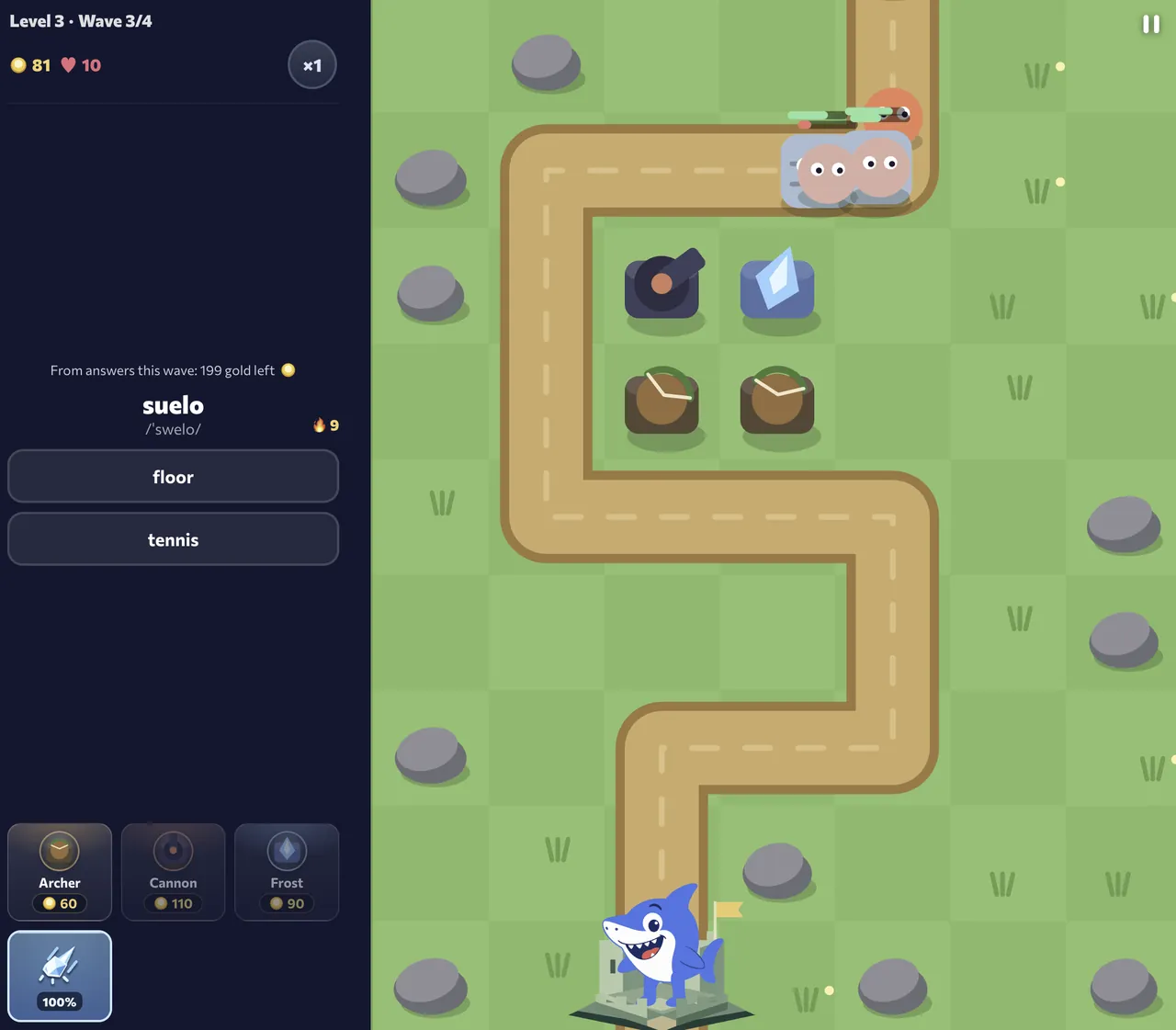
Screenshots show the English interface and Spanish vocabulary; the words and translations in your session depend on the selected course.
Fluera Jump: jumping game
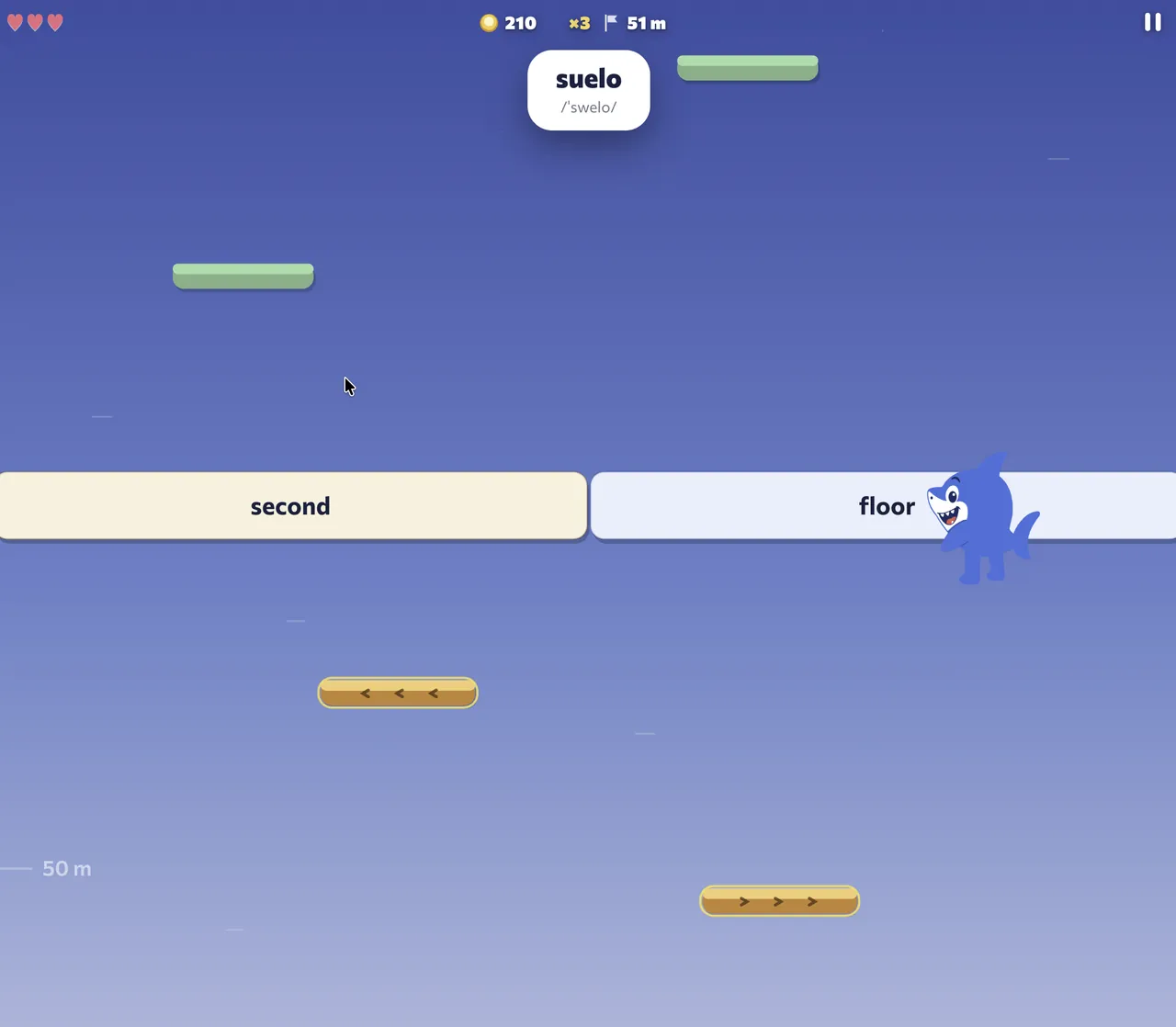
Fluera bounces upward on her own. Stretches of jumping alternate with question rows: two boards, two translations, and the side you land on is your answer. Steer by dragging, with the arrow keys or by tilting your phone. Read about Fluera Jump.
Fluera Run: endless runner
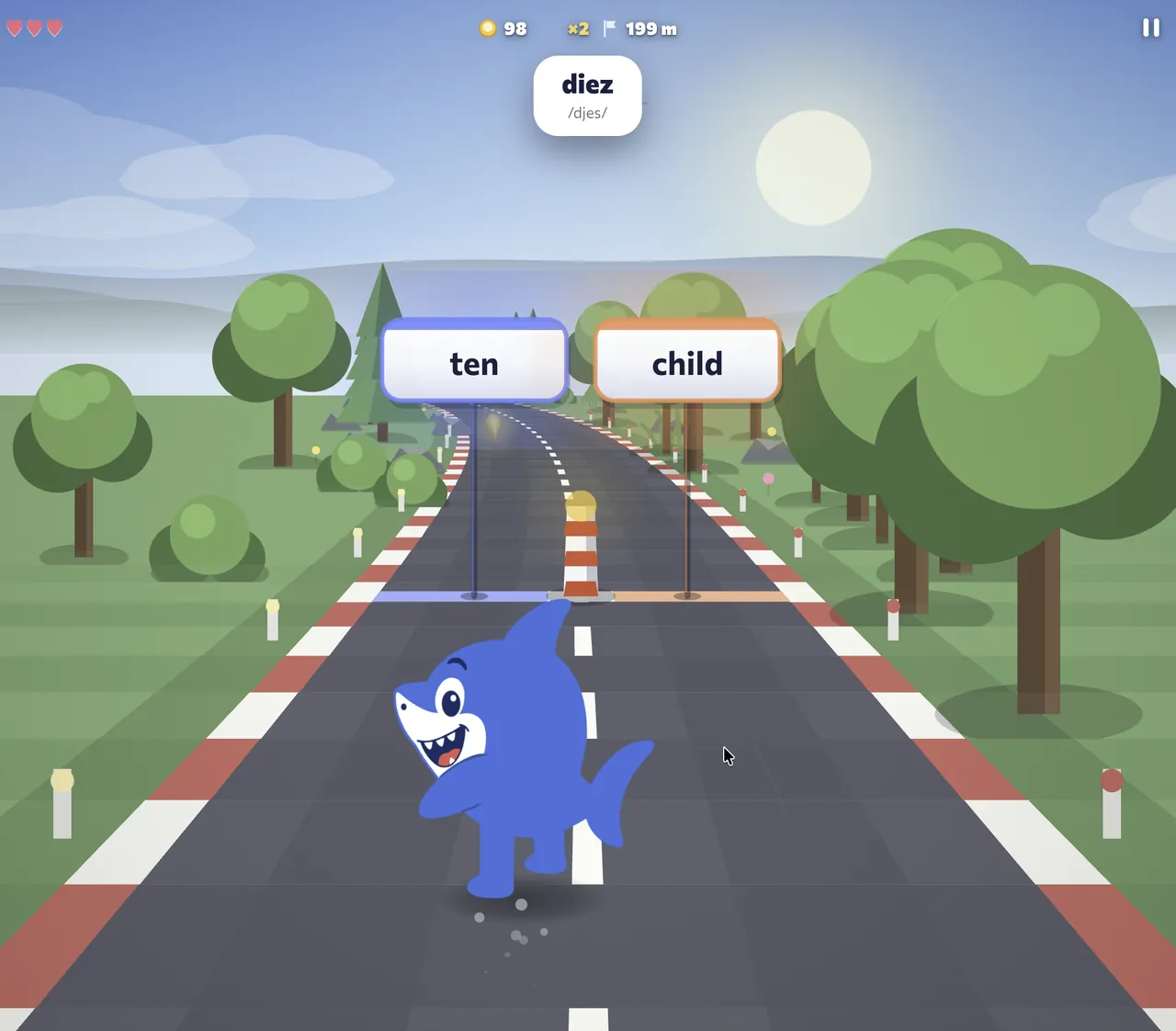
A prompt word appears and the translations are laid out on the lanes ahead. Swipe into the right lane, jump or slide to answer. Assist mode keeps every question left-or-right for players who want to focus on the words. Read about Fluera Run.
Which words the games use
The games draw on Fluera’s courses: Spanish, French, German and Portuguese vocabulary with English translations. Read all the translation options before choosing the one that matches the word.
When you sign in, the games use your learning progress to choose words. Words due for review come first, then words you are learning, then new words. A word you first meet in a game enters your dictionary as “learning” and comes back the next day in Review. A learned word you miss in a game returns to the review queue. As a guest you get words at the chosen difficulty in random order.
Why games for learning vocabulary work
Repetitions without fatigue
Fluera Run includes vocabulary questions throughout each run, so practicing words becomes part of the action.
Answers with a cost
A wrong lane, a lost life or lost gold makes you read the word properly. That small stake is what separates a vocabulary game from a list.
Recognition at speed
The games ask you to recognize written words while you play. This gives you practice choosing meanings under time pressure; listening and speaking require separate practice.
The same dictionary as your lessons
Nothing you learn in a game is lost in a separate app. Every answer updates the word record that lessons, Review and Mistakes also use.
Choose a language
- Games for learning Spanish words
- Games for learning French words
- Games for learning German words
- Games for learning Portuguese words
On your phone or computer
Each game shows its controls the first time; Fluera Jump also supports tilt steering on phones.
You can play in your browser without installing anything. On phones and tablets, our Fluera app for Android and iOS is the more convenient way to play. Choose your store below.


Guests and accounts
You can start playing without an account. Guest access is subject to usage limits, and guest records stay in the browser. Registration is free and optional: sign in when you want the games to work on your own vocabulary, save stars and best scores, and count toward your daily streak.
Compare the games by the decision you make
The clearest way to choose is to imagine what you want your hands to do while you read a word. Tower separates translation questions from decisions about where to build. Jump turns the answer into a landing on one of two platforms. Run asks you to coordinate a translation with a movement on the track. The vocabulary task is related, but the rhythm and the control demands are different.
Choose Tower when you enjoy planning and want a campaign with individual battles. Choose Jump when you like a compact climbing challenge and side-to-side movement. Choose Run when an obstacle course makes you want to try again. You can switch games without starting a separate vocabulary collection, although the next round is not guaranteed to show the same words in the same order.
Your first round is also a controls lesson
Before judging your vocabulary, learn how the selected game registers an answer. In Jump you need to reach the correct board; in Run the required movement depends on the question and control mode. In Tower a translation earns resources, but you must still spend them on a useful defense. Reading the correct meaning and executing the action are two parts of the round.
For the first attempt, use familiar words and follow the controls shown on screen. Do not try to maximize speed at the same time as learning a new gesture. If the controls take all your attention, practice with familiar words or use a direct-answer activity first. A short, understandable round gives you more useful feedback than a long sequence of guesses.
What a vocabulary game can tell you
A correct choice shows that you identified the expected translation among the options presented. That is useful, but narrower than being able to recall the word without a prompt, pronounce it, understand it in fast speech or use it in your own sentence. The games concentrate on recognition; course and list exercises provide other ways to work with the word.
Try a small check after playing: choose one word that caused hesitation and explain its meaning without looking at the answer choices. Then open an example and see whether the meaning fits that sentence. If it does not, the useful next step is contextual study. Playing the same style of question faster would not resolve the misunderstanding by itself.
Separate a language mistake from a movement mistake
A late jump can end a good run even when you understood the word. A poor tower position can let an enemy through after a correct translation. Likewise, a lucky movement can land on the right answer without real recognition. For this reason, distance, height and campaign stars should be read as game results, not as a complete assessment of language ability.
When you miss a word, read the correction before starting again. If you knew the meaning, identify the movement that failed. If you did not know it, check the word and its example in your dictionary. This distinction helps you decide whether to practice the controls, choose more accessible vocabulary or spend a few minutes learning before the next round.
Choose a realistic stopping point
A campaign victory, a finished run or one attempt at a better height can each be a useful stopping point. You do not have to beat a personal record for the session to have value. A round where you carefully read several corrections can be more informative than a record reached by guessing through unfamiliar vocabulary.
If you notice that you are tapping before reading, take a break or switch to a slower exercise. The purpose of adding play is to make repetition easier to return to, not to turn every free minute into a score chase. Pick the game whose rhythm leaves you enough attention for the words. That choice may change with the device, the day and the vocabulary you are studying.
Connect a game to your next learning step
After a round, use Mistakes for the words you got wrong when playing with an account. Use Review for vocabulary that is due. Open a lesson or list when you need new examples or want to study a particular topic deliberately. Each destination solves a different problem, so there is no required sequence of three games followed by every other exercise.
For an exact word selection, stay with a list or selected-word practice. The game chooses words based on your course and learning progress; choosing a game from a language page does not turn it into a custom deck containing only that page’s examples. The sample words on a language page illustrate the direction, while an actual round draws from the relevant vocabulary pool.
Compare progress under similar conditions
Use the same course, similar vocabulary difficulty and the same control mode when comparing attempts. Switching from a keyboard to touch, enabling assistance or choosing a harder word set can change a result even when your vocabulary has improved. Notice whether meanings come to mind with less hesitation and whether previously confused words become easier to distinguish. Those observations help you choose what to study next without asking a game score to measure skills it does not test.
Frequently asked questions
Are the games free?
Which languages can I learn with the games?
Do I need to download anything?
Which game should I start with?
Do game answers count as learning?
Learn words in context
Games help you practice recognizing translations. For example sentences, audio and broader practice, continue with a word list or a language course.