Games for learning French words: free French vocabulary games online
Practice French vocabulary with translations into English in three browser games. Fluera Tower rewards correct translations with gold to build and upgrade towers, Fluera Jump makes the platforms your answers, and Fluera Run puts the translations on the lanes of an endless runner. The words come from Fluera’s French course, from beginner to upper intermediate, and every game starts without registration.
Choose a game
{# Crawlable fallback for the same cards mounted by PublicPracticeCards.jsx. Decorative SVG artwork is added by the shared client card component. #}A taste of the vocabulary
Which French words you practice
The games use the vocabulary of Fluera’s French course, organized by level and theme.
At beginner level (A1–A2) that means greetings, numbers, family, food and drink, the home, the city, travel, and everyday verbs and adjectives. At intermediate level (B1–B2) the vocabulary moves on to work and study, feelings and opinions, media, society, abstract vocabulary and common set expressions.
The question shows a word from the language you are learning and asks you to choose its translation. Read all the options: a familiar-looking answer is not enough unless its meaning matches the prompt.
When you sign in, the games use your learning progress to choose words: words due for review first, then words you are learning, then new words. A French word you first meet in a game enters your dictionary as “learning” and comes back the next day in Review.
How each game teaches French
Fluera Tower
A tower defense game where each question shows a French word and two English translations. Correct answers earn you gold to build and upgrade towers. About Fluera Tower.
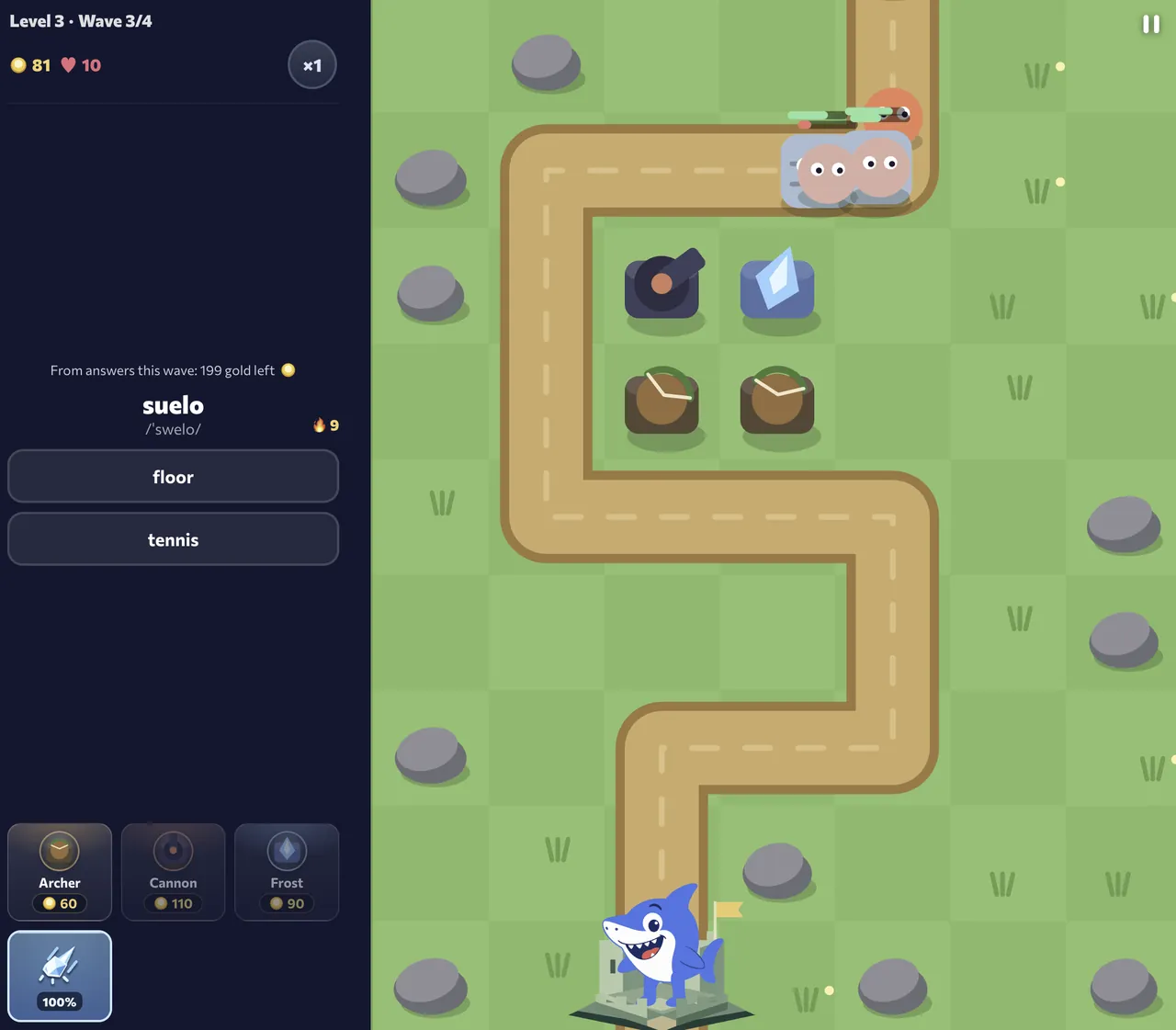
Screenshots show the English interface and Spanish vocabulary; the words and translations in your session depend on the selected course.
Fluera Jump
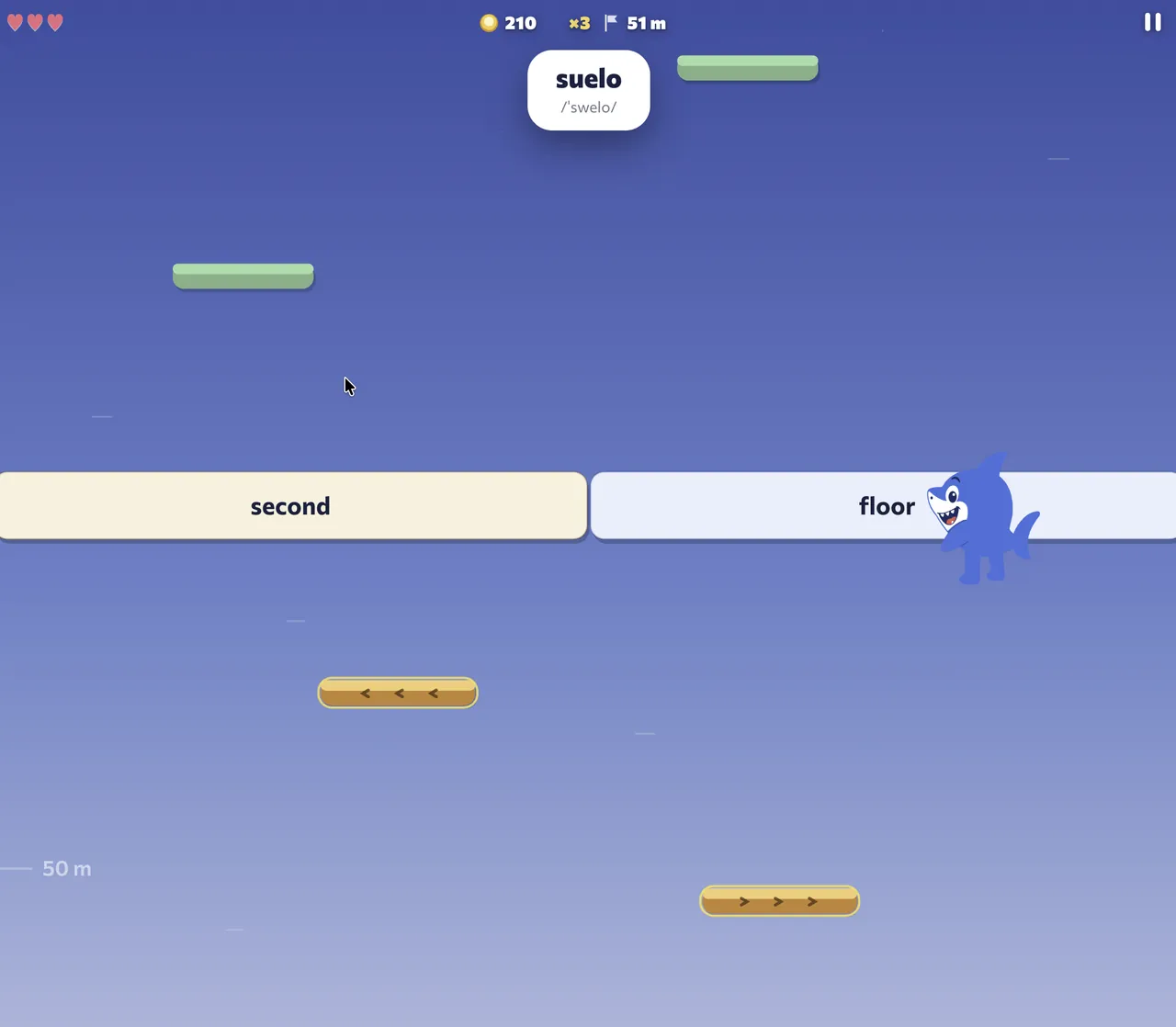
A vertical jumping game. An occasional question row shows a French word and two boards with English translations; land on the right one. Quick and relaxed, good for a phone. About Fluera Jump.
Fluera Run
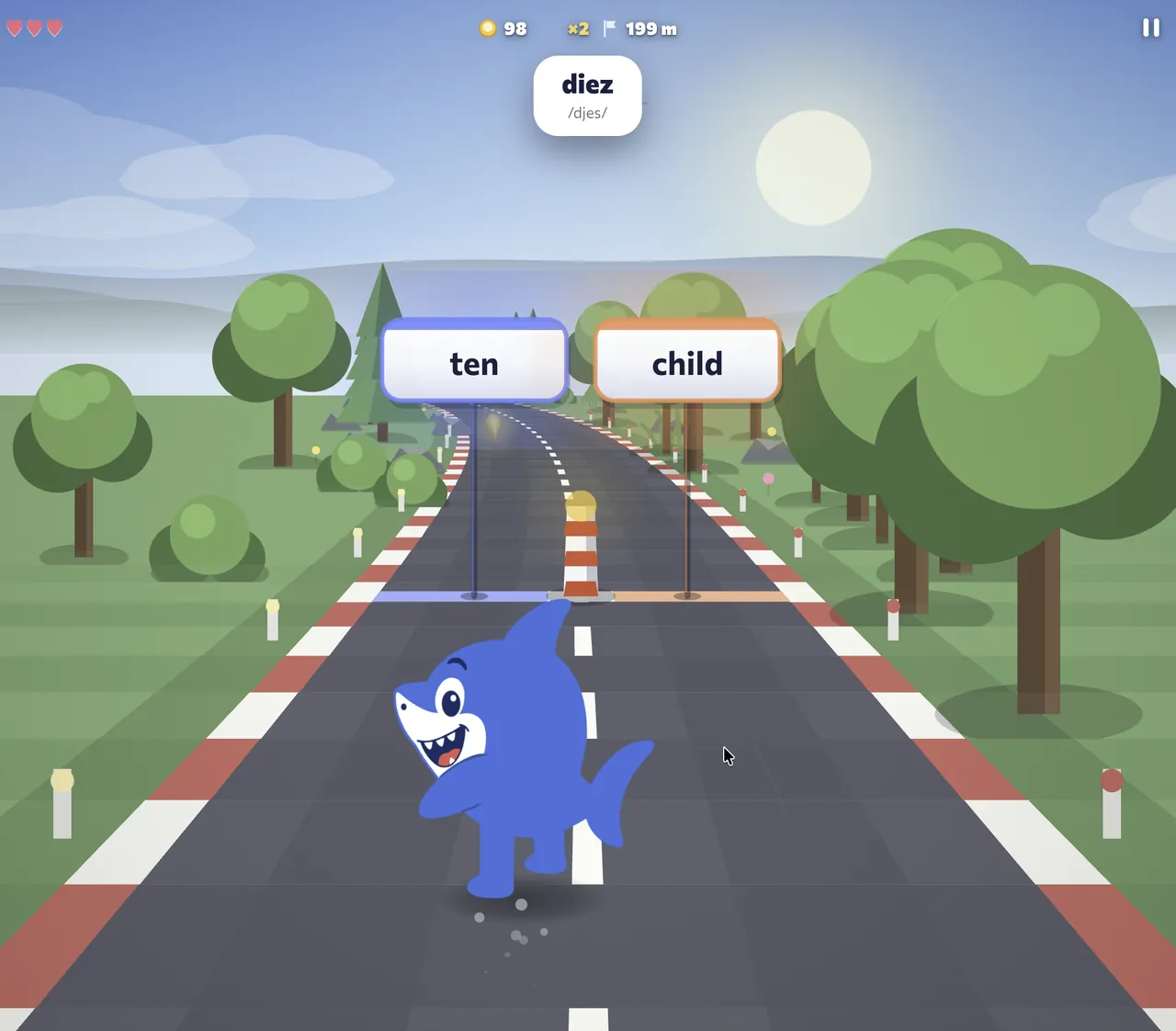
An endless runner. The French word appears, translations sit on the lanes, and you swipe into the right one or jump and slide to answer. A fast-paced way to practice. About Fluera Run.
Why games are a good way to learn French vocabulary
Recognition first
The game asks you to recognize a written word and choose its meaning while the round continues. This helps you practice recognition under time pressure. Listening, pronunciation and using words in sentences require separate practice.
More practice in a short session
Each round includes vocabulary questions. How many you answer depends on the length of the round and your pace. Choose a session length that leaves time to read corrections and return to difficult words afterward.
Built on the course
The same French vocabulary appears in lessons with example sentences and audio, in Review and in Mistakes. A game is one more place the word shows up, not a separate app.
On your phone or computer
Use the controls shown in each game.
You can play in your browser without installing anything. On phones and tablets, our Fluera app for Android and iOS is the more convenient way to play. Choose your store below.


Guests and accounts
You can start playing without an account. Guest access is subject to usage limits. Registration is free and optional: sign in when you want the games to work on your own French vocabulary and keep your progress.
Look beyond a familiar-looking French word
Some French words resemble English words, which can help you start reading. Resemblance is a clue, not a complete definition. Read the full prompt and compare the actual meanings offered rather than choosing solely because a spelling looks familiar. After a mistake, check the intended sense in an example sentence. This is especially useful when a word seems obvious but the correction surprises you.
The sample vocabulary on this page illustrates French with English translations. It is not a fixed set that every game round repeats. The game uses the selected course and your learning progress. If you want to work on an exact group, use its list or choose words in the dictionary before returning to broader game practice.
Three useful follow-ups for French vocabulary
Learn a noun in a phrase
A translation choice focuses on meaning. In a sentence, a French noun also appears with an article and may have an adjective nearby. During slower study, read those words together. Notice the article shown by the example rather than trying to infer every grammatical property from the English translation alone. The purpose is to connect recognition to actual use.
You can keep the follow-up small: one noun, one clear example and a check of its meaning. There is no need to interrupt a game to study every related grammar rule. Return to a lesson when the same construction keeps causing uncertainty.
Connect spelling and sound
Written French and spoken French can feel like different tasks to a learner. Recognizing a word on the screen does not automatically mean you will identify it in a sentence recording. Open the available audio after playing, listen to the word and then its example, and compare what you hear with the written form. Do this without requiring another high-speed answer at the same time.
Pay attention to the whole written form when reading. Accents and endings belong to the word, even when your immediate goal is choosing a translation. In a listening follow-up, use the actual recording rather than relying only on how an English reader would pronounce those letters.
Keep expressions together
If the prompt contains several words, read all of them. A familiar component does not always give the meaning of the complete expression. After the round, look for the expression in a sentence and explain the meaning of the whole group. This helps avoid answering from the first recognizable fragment while missing the rest of the task.
Start with a manageable French round
Choose words at a comfortable level while you learn the game controls. In Tower, translation and building are separate decisions. In Jump, the choice must become a landing. In Run, it must become the movement required by the current question. A short first attempt can teach that rhythm without also requiring you to decipher mostly unknown vocabulary.
After finishing, separate the two kinds of difficulty. If the meaning was clear but the action was late, adjust the control practice. If the action was easy but the translation uncertain, study the word. If both were difficult, simplify one before restarting. The next attempt becomes more useful when you know which part you want to improve.
Do not make one English gloss do every job
The correct option is the translation expected for the prompt’s intended meaning. Another French sentence can require different English wording. Use the dictionary example to check context before assuming that a single short gloss covers every use. This matters particularly when a familiar word has several related senses.
For a specific reading or travel task, build a relevant list and study its examples. The games offer recognition practice across the course; they do not guarantee that every next question will belong to your exact topic. Combining a precise list with a broader game gives each activity a clear role.
Read a result as a guide to the next word
Compare attempts using the same course, a similar word level and the same controls. A change in device, assistance or question familiarity can alter the result. Notice whether you read French prompts more comfortably and confuse fewer meanings. Height, distance and stars do not certify French proficiency, but a round can show which word, sound or example deserves your next few minutes.
Frequently asked questions
Are the French games free?
Which level of French do I need?
Do the games teach French grammar?
Can I learn French using a language other than English?
Can I choose the exact words for my next game?
Learn French words in context
Games help you practice recognizing translations. For example sentences, audio and the full course, continue here.
Learn French · French word lists · Games for learning languages · Vocabulary practice