Games for learning Spanish words: free Spanish vocabulary games online
Practice Spanish vocabulary with translations into English in three browser games. Fluera Tower rewards correct translations with gold to build and upgrade towers, Fluera Jump makes the platforms your answers, and Fluera Run puts the translations on the lanes of an endless runner. The words come from Fluera’s Spanish course, from beginner to upper intermediate, and every game starts without registration.
Choose a game
{# Crawlable fallback for the same cards mounted by PublicPracticeCards.jsx. Decorative SVG artwork is added by the shared client card component. #}A taste of the vocabulary
Which Spanish words you practice
The games use the vocabulary of Fluera’s Spanish course, organized by level and theme.
At beginner level (A1–A2) that means greetings, numbers, family, food and drink, the home, the city, travel, and everyday verbs and adjectives. At intermediate level (B1–B2) the vocabulary moves on to work and study, feelings and opinions, media, society, abstract vocabulary and common set expressions.
The question shows a word from the language you are learning and asks you to choose its translation. Read all the options: a familiar-looking answer is not enough unless its meaning matches the prompt.
When you sign in, the games use your learning progress to choose words: words due for review first, then words you are learning, then new words. A Spanish word you first meet in a game enters your dictionary as “learning” and comes back the next day in Review.
How each game teaches Spanish
Fluera Tower
A tower defense game where each question shows a Spanish word and two English translations. Correct answers earn you gold to build and upgrade towers. About Fluera Tower.
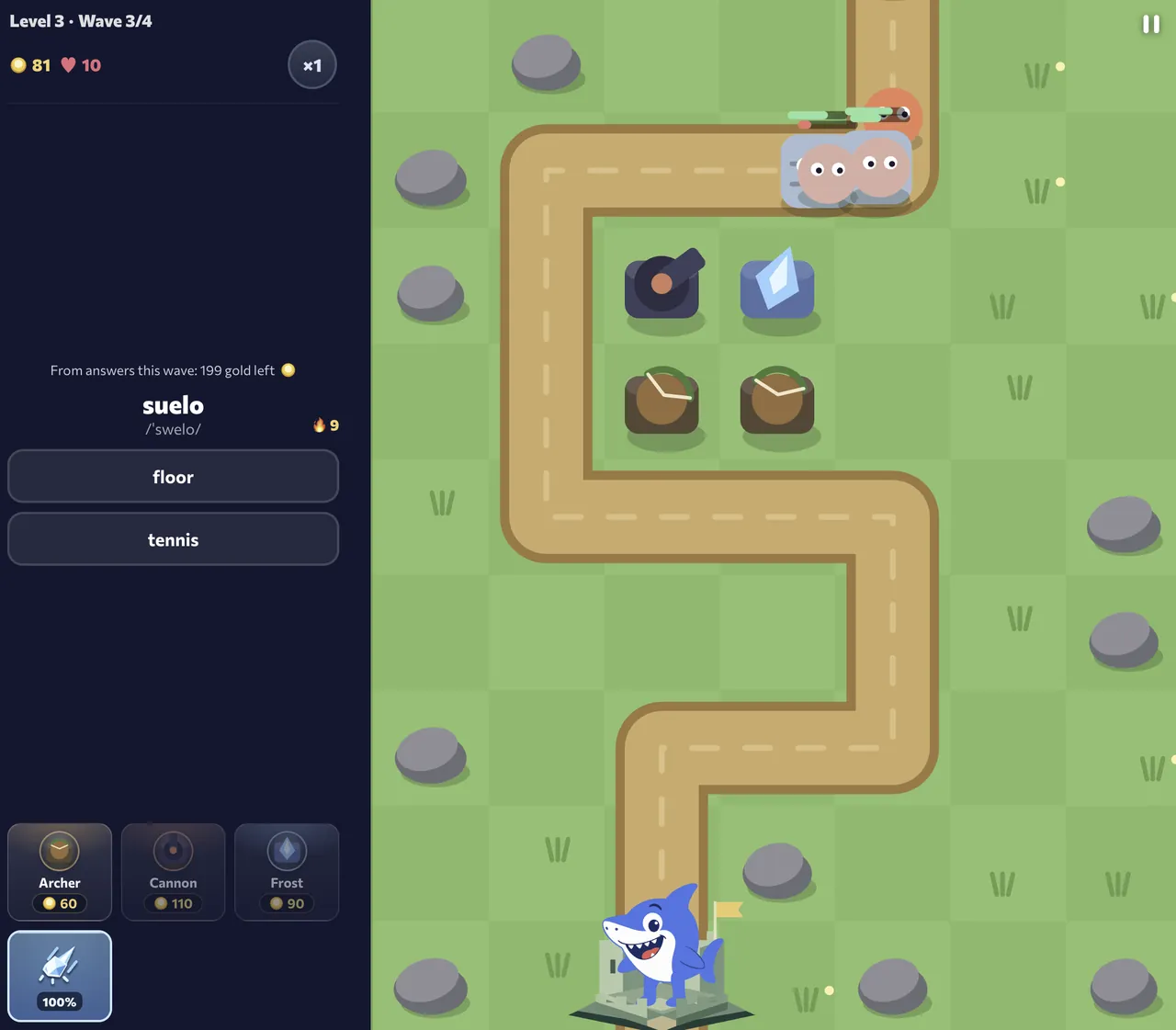
Screenshots show the English interface and Spanish vocabulary; the words and translations in your session depend on the selected course.
Fluera Jump
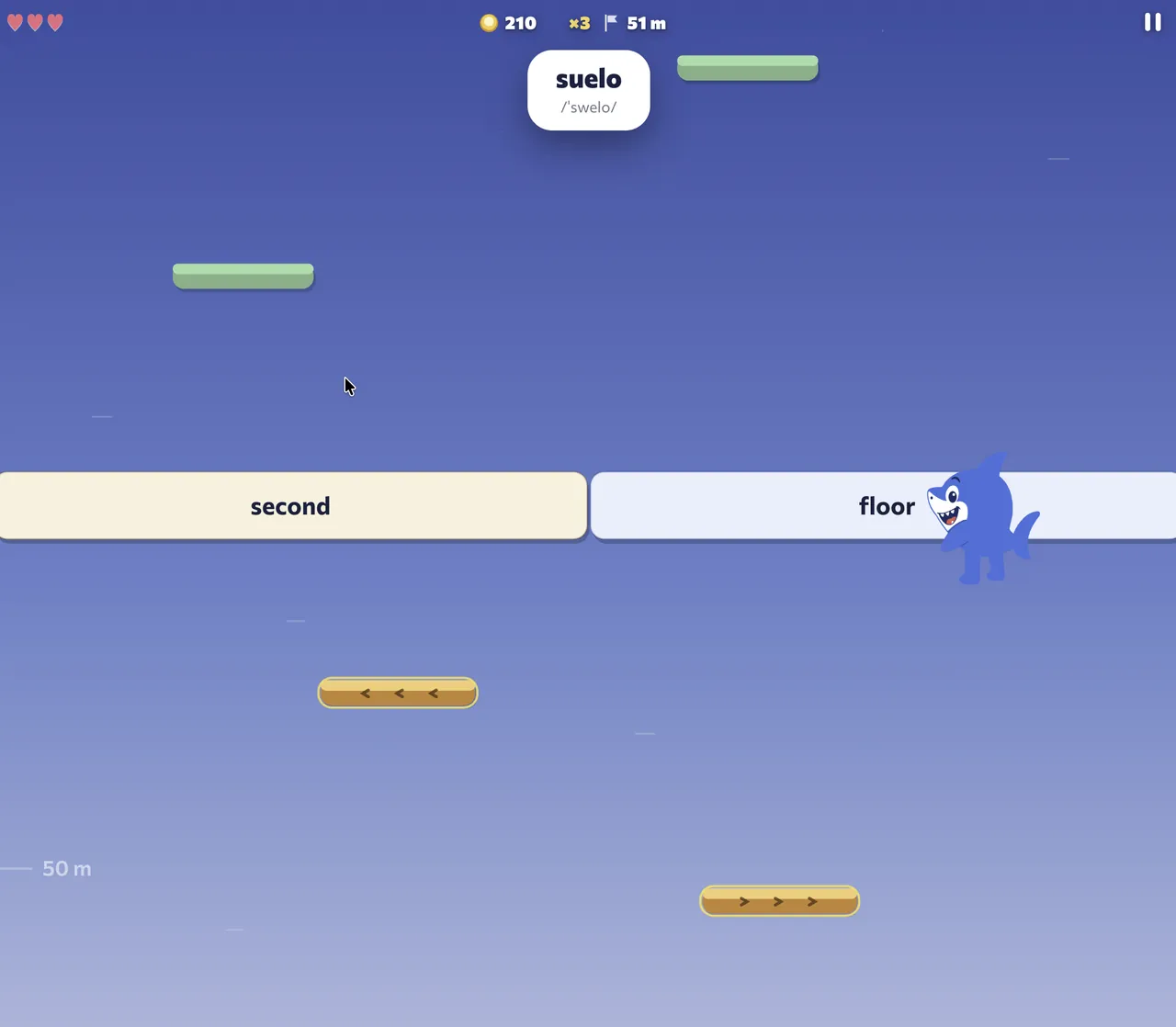
A vertical jumping game. An occasional question row shows a Spanish word and two boards with English translations; land on the right one. Quick and relaxed, good for a phone. About Fluera Jump.
Fluera Run
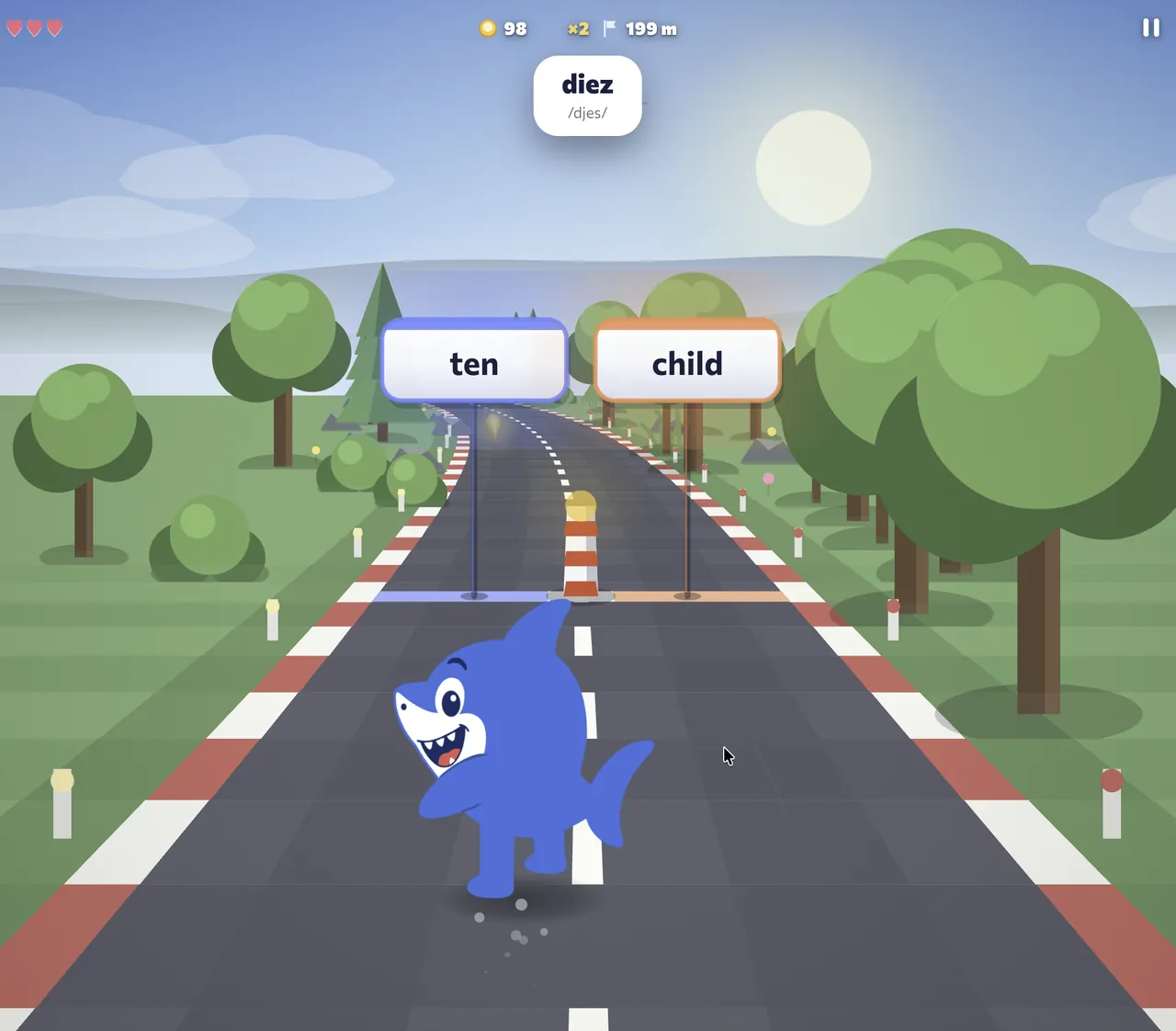
An endless runner. The Spanish word appears, translations sit on the lanes, and you swipe into the right one or jump and slide to answer. A fast-paced way to practice. About Fluera Run.
Why games are a good way to learn Spanish vocabulary
Recognition first
The game asks you to recognize a written word and choose its meaning while the round continues. This helps you practice recognition under time pressure. Listening, pronunciation and using words in sentences require separate practice.
More practice in a short session
Each round includes vocabulary questions. How many you answer depends on the length of the round and your pace. Choose a session length that leaves time to read corrections and return to difficult words afterward.
Built on the course
The same Spanish vocabulary appears in lessons with example sentences and audio, in Review and in Mistakes. A game is one more place the word shows up, not a separate app.
On your phone or computer
Use the controls shown in each game.
You can play in your browser without installing anything. On phones and tablets, our Fluera app for Android and iOS is the more convenient way to play. Choose your store below.


Guests and accounts
You can start playing without an account. Guest access is subject to usage limits. Registration is free and optional: sign in when you want the games to work on your own Spanish vocabulary and keep your progress.
Build recognition without losing the Spanish word
When an English translation appears beside a Spanish prompt, it is easy to let the English occupy all your attention. Read the Spanish word first and try to recall its meaning before looking for the matching option. The answer choices help you decide, but the connection you want to keep is between the Spanish form and the meaning. After the round, check whether you can recall that meaning without the choices.
Use the small vocabulary sample on this page as an illustration, not as a fixed deck for the next game. A round draws from the course vocabulary available for your level and learning progress. If you want to practice only a particular group, study its list or select those words in your dictionary. The language page chooses a direction; it does not replace the game’s vocabulary selection with six example words.
What to notice when studying Spanish between games
Nouns and their surrounding words
A fast translation question checks meaning, but a noun in a sentence also appears with other words. In your follow-up study, look at the article and at an adjective when the example includes one. Read the whole phrase rather than treating the noun as an isolated label. This is a practical way to give a recognized translation a grammatical context without expecting the game itself to explain agreement.
Verb meanings and forms
Recognizing the dictionary form of a verb does not make every form instantly familiar. When an example uses a different form, look at who performs the action and how the sentence places it in time. Compare the form with the dictionary entry. You do not need to learn an entire conjugation table during a game round; set aside that question for a lesson or a focused example after playing.
Written form and pronunciation
Pay attention to the complete spelling, including written accents, when you study a word. Then listen to the available word or sentence audio. A written translation choice cannot by itself show whether you would recognize the word in speech. Treat listening as a separate check and avoid turning an unfamiliar sound into a conclusion that the written meaning was never learned.
A first Spanish session with a clear sequence
Begin with a small amount of vocabulary you understand. Read the meanings, inspect a few examples, then choose the game whose controls leave you enough attention for the prompts. The goal of the first round can simply be reading every Spanish word before moving. You do not need to set a distance or height record while learning a new input method.
After the round, identify one useful follow-up. If several words were unknown, return to a lesson. If a small group was confused, compare their examples. If translations were clear but movement failed, practice the controls with a comfortable word level. This gives each restart a reason and separates language difficulty from game difficulty.
Use English translations as a starting point
An English gloss identifies the sense expected by the exercise, but languages do not divide every meaning in exactly the same way. A Spanish word may need different English wording in another sentence. Read an example before assuming that one short translation can replace the Spanish word everywhere. The game asks you to recognize the intended meaning among choices, not to translate every possible use of the word.
For reading practice, return to the Spanish sentence and follow how the word works there. For pronunciation, use audio. For an exact travel or work topic, choose a relevant list. These follow-ups complement the recognition game and keep it connected to a real use of the vocabulary.
Compare progress within this course
Keep the English-to-Spanish direction, a similar word level and the same controls when comparing attempts. New vocabulary or a different device can change the score independently of what you remember. Look for fewer hesitations on familiar words and clearer distinctions between meanings. A single game result is not an official Spanish level or a measure of conversation, but it can point to the next word or example worth studying.
Frequently asked questions
Are the Spanish games free?
Which level of Spanish do I need?
Do the games teach Spanish grammar?
Can I learn Spanish using a language other than English?
Can I choose the exact words for my next game?
Learn Spanish words in context
Games help you practice recognizing translations. For example sentences, audio and the full course, continue here.
Learn Spanish · Spanish word lists · Games for learning languages · Vocabulary practice